5 min read
EXPLAINER / Backline
Backline vs Sound: What's the Difference?
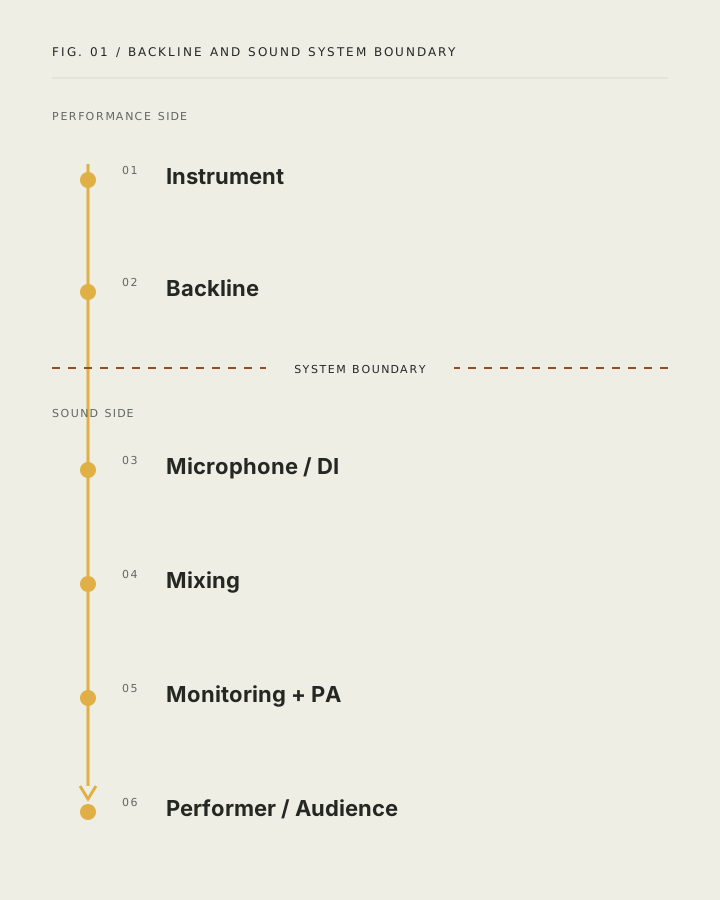
Backline is the equipment musicians perform with; the sound system captures, mixes, monitors and reproduces that performance. A guitar amplifier, drum kit or keyboard may be backline. The microphones, DI boxes, mixing consoles, stage monitors and PA used to carry those instruments to the performers and audience generally belong to the sound system. The two systems meet on stage, which is why their responsibilities are sometimes confused.
On this page ↓
Understand the difference between backline and sound equipment, where the two systems meet, what each usually includes and how production responsibilities should be divided.
The simplest way to understand the difference
Consider a guitarist.
The guitarist plays:
Guitar → Guitar amplifier
Those are part of the performer's instrument and backline system.
The amplifier may then be captured:
Guitar amplifier → Microphone → Mixing console → PA → Audience
The microphone, console and PA belong to the sound system.
The same principle applies to many instruments.
A keyboard is backline.
The DI box connecting it to the console is normally part of the audio system.
A drum kit is backline.
The microphones capturing that drum kit are normally part of the sound system.
What usually belongs to backline?
Typical examples include:
- drum kits
- cymbals
- drum hardware
- guitar amplifiers
- guitar speaker cabinets
- bass amplifiers
- bass speaker cabinets
- keyboards
- synthesizers
- digital pianos
- keyboard stands and pedals
- percussion
- electronic drum equipment
- artist-specific performance equipment
What is included depends on the technical rider and production agreement.
What usually belongs to sound?
Typical sound-system equipment includes:
- microphones
- DI boxes
- microphone stands
- stage boxes
- audio multicore/network infrastructure
- FOH console
- monitor console
- signal processing
- wireless microphone systems
- in-ear-monitor systems
- stage monitors
- PA loudspeakers
- subwoofers
- system processing
Again, exact responsibilities vary by production.
Where do backline and sound meet?
They meet at the point where the performer's equipment enters the audio system.
That boundary is particularly easy to see with an amplifier.
Instrument → Amplifier → Microphone → Console → PA
The amplifier belongs to the performance system.
The microphone begins the sound-system chain.
With a keyboard:
Keyboard → DI → Console → PA
The keyboard is backline.
The DI normally belongs to sound.
This boundary is not merely terminology. It helps determine:
- who supplies each item
- who prepares it
- who checks it
- who connects it
- who supports it during the show
Why is the distinction important?
Because the words on an equipment list also imply responsibility.
If a rider requests:
Fender Twin Reverb
someone needs to establish who supplies the amplifier.
If it requests:
SM57 on guitar amplifier
someone needs to establish who supplies the microphone, stand, cable and input.
Those responsibilities may sit with different suppliers.
On a simple production, one company may supply everything.
On a larger production, responsibilities may be divided between:
- production company
- sound company
- backline provider
- artist touring party
- venue
- promoter
The equipment still needs to function as one system even when several teams supply it.
Why shouldn't sound and backline simply be treated as one department?
Operationally, they require different kinds of attention.
Professional audio equipment is largely concerned with:
- signal flow
- gain structure
- routing
- processing
- coverage
- monitoring
- RF
- system operation
Backline involves:
- instrument configurations
- musician preferences
- model familiarity
- physical setup
- hardware
- tuning and preparation
- artist-approved substitutions
- performance ergonomics
There is considerable interaction between the two, but expertise in one does not automatically imply expertise in the other.
This becomes particularly important when technical riders are detailed or artist expectations are high.
Where do responsibilities overlap?
Some items sit close to the boundary.
Examples can include:
- DI boxes
- instrument microphones
- keyboard mixers
- playback interfaces
- electronic drum outputs
- instrument wireless systems
- in-ear systems associated with individual musicians
There is no benefit in arguing about which category an item theoretically belongs to.
The useful question is:
Who is responsible for supplying, preparing, connecting and supporting it for this production?
The technical advance should answer that.
A practical example
Imagine a bass player requiring:
Bass guitar → amplifier head → 4×10 cabinet
The bass rig is backline.
The production may take the bass signal using:
DI → stage box → console
and possibly:
Microphone on cabinet → stage box → console
Those elements belong to the audio signal chain.
The bassist experiences it as one performance system.
Production teams therefore need a clear division of responsibility and good coordination across that division.
Common mistakes
Assuming the PA supplier is supplying backline
Never assume this unless the scope confirms it.
Assuming the backline provider supplies microphones
Backline and microphone requirements should be scoped separately.
Reading the rider department by department
A rider describes one show. Requirements frequently interact across departments.
Discovering responsibility gaps at soundcheck
If everyone assumed someone else was supplying an item, the distinction between departments has failed operationally.
Treating equipment handover as the boundary
Supplying equipment is only part of the job. Setup, connection, testing and show support also need clear ownership.
The better way to plan it
When reviewing a technical rider:
- identify each requirement;
- classify the equipment where useful;
- assign responsibility;
- identify interfaces between departments;
- confirm substitutions;
- confirm setup responsibility;
- resolve unclear items during the advance;
- verify the complete system before soundcheck.
The objective isn't to defend departmental boundaries.
The objective is to make them invisible to the performer.
Related questions
What is the difference between backline and sound?
Backline is the equipment musicians perform with; the sound system captures, mixes, monitors and reproduces that performance.
Is PA considered backline?
No. PA generally refers to the sound-reinforcement system used to deliver audio to the audience, while backline refers to the instruments and performance equipment musicians use on stage.
Are microphones part of backline?
Usually, general vocal and instrument microphones belong to the sound system rather than backline. There can be exceptions or overlapping responsibilities depending on the production and artist rider.
Are DI boxes backline?
DI boxes are generally considered part of the audio signal chain rather than backline, but responsibility should be confirmed in the production scope.
Does a sound company provide backline?
Not necessarily. Some production suppliers provide both, while others specialize in sound or backline. The scope and technical rider should establish responsibility.
Who connects backline to the sound system?
This is coordinated between the backline and audio teams. The precise division varies according to the equipment and production.