8 min read
EXPLAINER / Backline
What Is Backline?
Backline is the instruments, amplifiers and performance equipment musicians use on stage. It commonly includes drum kits, guitar amplifiers, bass rigs, keyboards, percussion and associated hardware. Backline is distinct from the PA and general sound system. The backline is what the musician performs with; the sound system captures, mixes, monitors and reproduces that performance.
On this page ↓
Learn what backline means in live production, what equipment it includes, how it differs from PA and sound, and how riders, substitutions, festivals and touring affect backline planning.
What equipment is considered backline?
There is no single equipment list that defines backline for every performance.
For a typical live band, backline may include:
- drum kit and associated hardware
- cymbals, when requested or supplied
- guitar amplifiers and speaker cabinets
- bass amplifiers and speaker cabinets
- keyboards, synthesizers and digital pianos
- keyboard stands and pedals
- percussion instruments
- electronic drum kits and percussion pads
- specialist instruments requested by the artist
The exact requirement depends on the artist, the performance and the technical rider.
This is why a request such as "one drum kit, two guitar amps and one bass amp" is only a starting point. A professional backline specification usually needs considerably more detail.
Where does backline sit in a live production?
This is where backline is often confused with sound equipment.
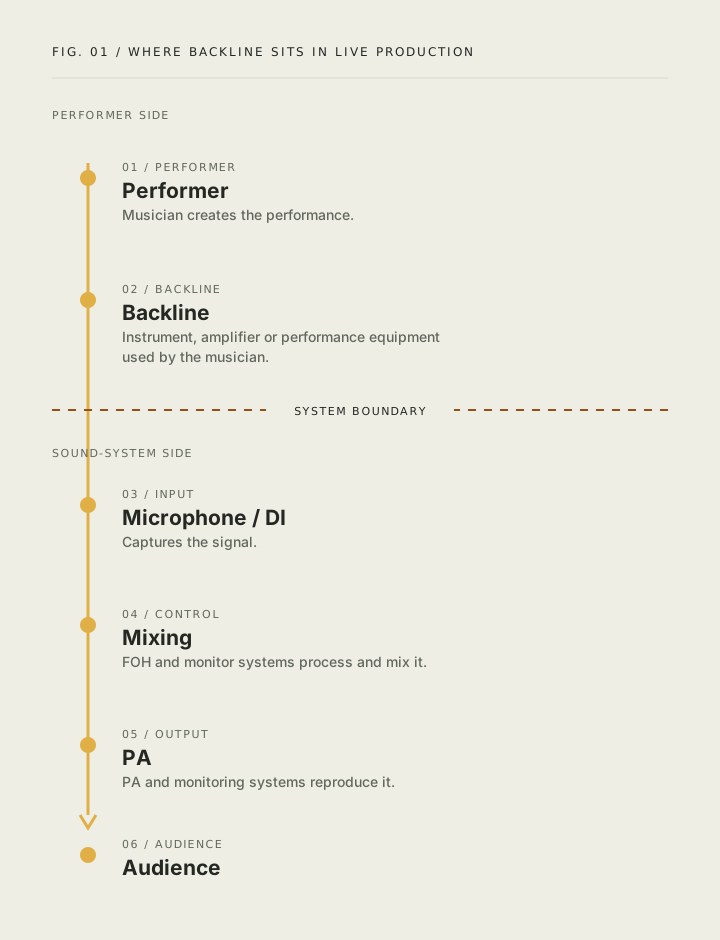
The basic path can be understood as:
Performer → Backline → Microphone / DI → Mixing → PA → Audience
Backline vs PA: what's the difference?
A useful distinction is:
Backline is primarily equipment the musician performs with.
The PA is primarily equipment used to deliver that performance to listeners.
For example, a guitarist may play through a guitar amplifier. That amplifier is backline.
A microphone may then be placed in front of the amplifier. The microphone feeds the audio system, where the signal is mixed and reproduced through the PA.
Likewise, a keyboard is backline. A DI box may connect that keyboard to the sound system.
The two disciplines therefore meet on stage, but they are not the same thing.
This distinction becomes particularly important when responsibilities are divided between a sound company, a production company and a specialist backline provider.
Who provides the backline?
There is no universal arrangement.
Depending on the production, backline may be:
Carried by the artist. Musicians often travel with personal instruments or equipment that is particularly important to their performance.
Provided locally. For touring artists, transporting large drum kits, amplifiers and keyboards between cities or countries may be impractical. Suitable equipment can instead be arranged at the destination.
Provided by the promoter or production. The event organiser may take responsibility for fulfilling the artist's backline rider.
Provided by a specialist backline company. A specialist provider can review the rider, source the required equipment, prepare it, deliver it, set it up and provide technical support.
Shared between artists. Festivals and multi-artist productions may establish a common or shared backline to reduce changeover time and duplication.
The technical advance should make these responsibilities explicit before the show.
The technical rider defines the real requirement
A professional technical rider does much more than say that an artist needs "a drum kit" or "a keyboard."
It may specify:
- manufacturer
- model
- configuration
- sizes
- quantity
- hardware
- accessories
- preferred alternatives
- setup notes
- stage position
- artist-specific requirements
Consider this difference:
"Pearl drum kit"
versus:
"Pearl Reference, 22-inch kick, 10/12-inch rack toms, 16-inch floor tom, snare, double pedal, hi-hat stand, three boom cymbal stands and drum throne."
Both describe a drum kit.
Only one begins to describe what the drummer actually expects to find on stage.
The same principle applies to keyboards, guitar amplifiers, bass rigs and percussion.
What happens if the exact requested model isn't available?
This is a normal part of backline planning, particularly when artists tour across different countries or cities.
An exact model may be:
- unavailable locally
- discontinued
- already committed to another production
- impractical to transport
- replaceable by an artist-approved alternative
The important part is approval.
Two pieces of equipment that appear similar on paper may behave or feel quite differently to the musician.
A substitution should therefore be identified during the advance and communicated before show day wherever possible.
What is shared backline?
At festivals and multi-artist shows, repeatedly replacing complete drum kits, amplifiers and other large equipment between acts can consume valuable changeover time.
Productions may therefore establish shared backline.
For example, several artists might agree to use:
- the same drum shells
- common hardware
- common amplifier cabinets
- selected keyboard stands
while musicians bring or request artist-specific items such as:
- snare drums
- cymbals
- pedals
- guitar amplifier heads
- keyboards
- specialist percussion
The exact arrangement should be agreed during the advance.
Shared backline is therefore not simply "everyone uses the same equipment." It is a planned compromise between production efficiency and performer requirements.
Why does backline matter during festival changeovers?
A changeover may look like a few minutes of activity between performances.
The work that makes those few minutes possible happens much earlier.
Backline teams need to know:
- what remains on stage
- what leaves the stage
- what changes between artists
- which hardware is shared
- which equipment belongs to each artist
- where replacement equipment is positioned
- what requires reconnection
- what needs line checking
- who is responsible for each movement
How does touring backline work?
Touring creates another challenge: consistency.
A musician may perform in Mumbai one night and another city shortly afterwards. The locally supplied equipment may come from different inventories, but the performer still expects a familiar and workable setup.
Touring backline planning therefore involves more than finding approximately equivalent equipment in each city.
It may require:
- comparing local inventories with the rider
- identifying exact matches
- agreeing substitutions
- maintaining consistent configurations
- coordinating between providers
- documenting artist preferences
- preparing each city before arrival
For the artist, the objective is simple: the stage should feel as predictable as reasonably possible from one performance to the next.
Common backline mistakes
Several problems recur because apparently small details are treated as assumptions.
Assuming "drum kit" includes everything
Cymbals, pedals, throne, snare and hardware may be separately specified.
Treating amplifier models as interchangeable
Different amplifier designs can respond very differently to the musician's instrument and playing style.
Checking only the main equipment
Stands, pedals, power supplies, benches, adapters and other accessories can stop an otherwise correct setup from being usable.
Ignoring model versions
Keyboard and electronic-instrument families can contain significantly different models and generations.
Making substitutions without approval
An alternative may be technically capable without being suitable for that particular artist.
Reviewing the rider too late
Questions that could have been solved days or weeks earlier become show-day problems.
Treating setup as delivery
Backline is not ready merely because the equipment has reached the venue. It needs to be checked, assembled, positioned and prepared for the performer.
Why professional backline preparation matters
Musicians build familiarity with their equipment.
The location of a pedal, the response of an amplifier, the feel of a keyboard action or the height of a drum throne may seem like small details outside the performance environment.
On stage, they matter.
Professional backline preparation is therefore partly about equipment and partly about removing avoidable variables from the performance.
When the rider has been properly advanced, the equipment has been checked and the setup has been prepared correctly, soundcheck can concentrate on the show rather than solving preventable equipment problems.
That is the real purpose of good backline support.
Related questions
What is backline?
Backline is the instruments, amplifiers and performance equipment musicians use on stage.
What equipment is considered backline?
There is no single equipment list that defines backline for every performance. The exact requirement depends on the artist, the performance and the technical rider.
Is a guitar amplifier considered backline?
Yes. Guitar amplifiers and their speaker cabinets are commonly considered backline because they form part of the equipment the guitarist performs through on stage.
Are keyboards considered backline?
Yes. Keyboards, synthesizers, digital pianos, stands and associated performance accessories are commonly part of backline.
Are microphones part of backline?
Usually, general vocal and instrument microphones belong to the sound system rather than backline. There can be exceptions or overlapping responsibilities depending on the production and artist rider.
Who supplies backline?
It varies. Equipment may travel with the artist, be provided by the promoter or production company, be rented locally from a specialist provider, or be shared between artists at a festival.
Why do touring artists rent backline?
Large drum kits, amplifiers, keyboards and other equipment can be expensive and impractical to transport between cities or countries. Local rental allows the touring party to specify suitable equipment while reducing transport requirements.
What happens when requested backline is unavailable?
The requirement should be advanced with the artist or technical representative and a suitable alternative proposed for approval. Substitutions should ideally be resolved before show day.